Recently, the Southern Functional Feed Development and Utilization Innovation Team from the Institute of Bast Fiber Crops, Chinese Academy of Agricultural Sciences (CAAS), published a cutting-edge review in Redox Biology, a world-leading journal in oxidative stress research. The study systematically elucidates the protective mechanisms of cannabidiol (CBD) in intestinal health, providing novel theoretical foundations and scientific support for intestinal nutritional health and the prevention and treatment of intestinal diseases such as inflammatory bowel disease (IBD).
Entitled "The dual roles of natural cannabidiol in combating oxidative stress and inflammation: A potential intestinal guardian", this research delves into the tremendous potential of CBD-a safe, non-psychoactive, and non-addictive cannabinoid-in intestinal nutritional health and disease prevention. The study highlights that oxidative stress and redox imbalance are critical drivers of epithelial barrier dysfunction, chronic inflammation, and disease progression in intestinal disorders including IBD and colorectal cancer. Leveraging its remarkable antioxidant and anti-inflammatory properties, CBD demonstrates unique intestinal protective effects.
The research team systematically mapped the redox-related mechanisms underlying CBD's intestinal protection, with particular emphasis on its multiple molecular targets. On one hand, CBD modulates reactive oxygen species (ROS) generation, activates the Nrf2–Keap1 antioxidant pathway, and regulates redox-sensitive inflammatory signaling pathways including NF-κB and the NLRP3 inflammasome. On the other hand, CBD acts on the endocannabinoid system (ECS) and related receptors to maintain intestinal epithelial barrier integrity and modulate gut microbiota composition, thereby synergistically improving intestinal oxidative stress and inflammatory status. Furthermore, the article discusses CBD's regulatory roles in the gut-organ axes (including the gut-brain and gut-liver axes), revealing its broad potential from localized intestinal protection to systemic health maintenance. This study synthesizes existing evidence on how CBD integrates redox regulation, inflammation control, intestinal barrier protection, and gut microbiota modulation, establishing a mechanistic framework for its potential applications in intestinal diseases and health.
This research was supported by the National Natural Science Foundation of China, Science and Technology Innovation Program of Hunan Province, Hunan Provincial Key Laboratory of the Traditional Chinese Medicine Agricultural Biogenomics, and the Yuelu Young Scientist Program of the Institute of Bast Fiber Crops, CAAS.
Original Article: https://doi.org/10.1016/j.redox.2026.104051
By Qian Lin
(linqian@caas.cn)
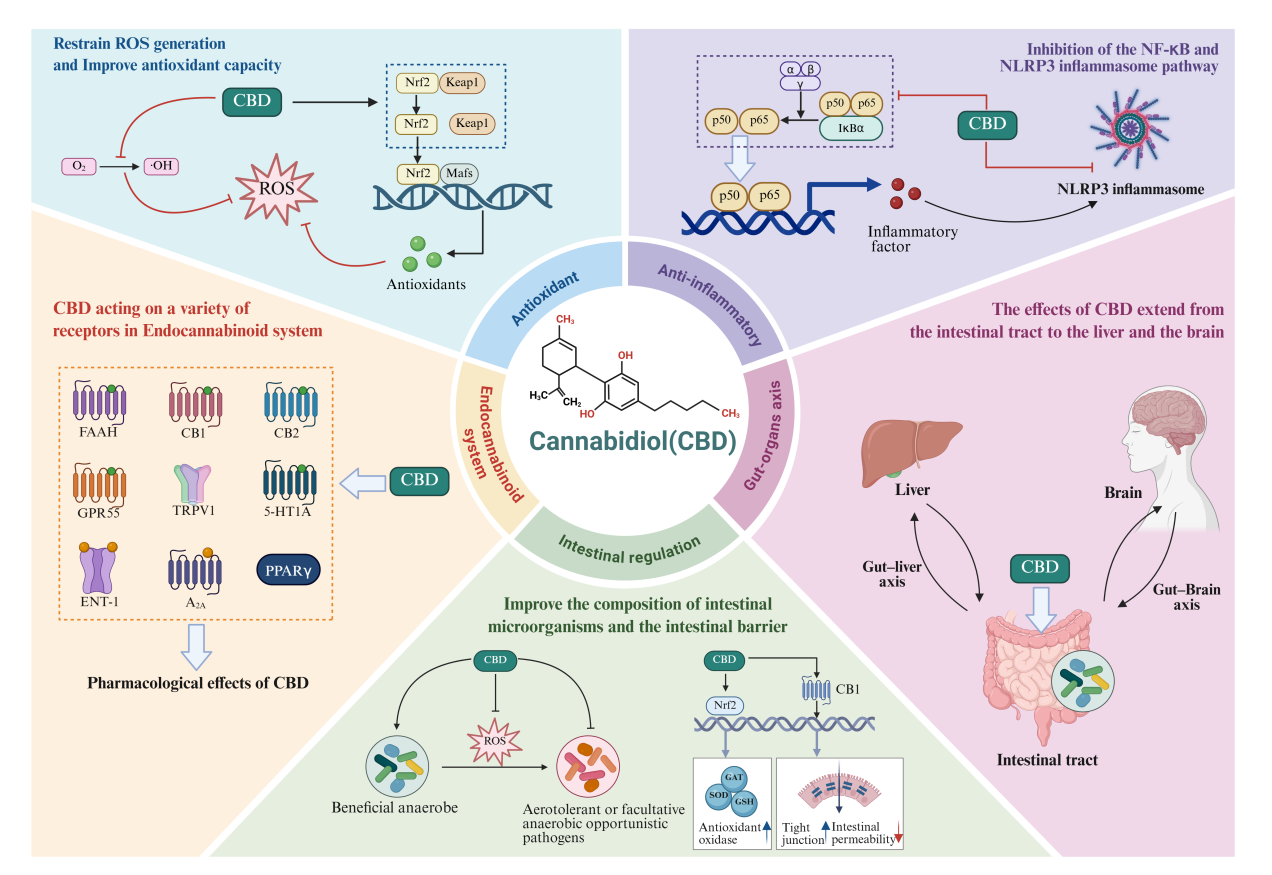
Cannabidiol (CBD) demonstrates significant potential in maintaining intestinal homeostasis and regulating the
intestinal-organ axis by exerting antioxidant and anti-inflammatory effects and interacting with the endogenous cannabinoid system (ECS)