Recently, the Southern Characteristic Crop Genetics and Breeding Innovation Team of the Institute of Bast Fiber Crops, Chinese Academy of Agricultural Sciences (IBFC, CAAS), in collaboration with Hunan University, developed a novel biomaterial derived from active ingredients in Citrus aurantium L. and Rheum palmatum.
This study leveraged the unique molecular structures of hesperidin (HSD) and emodin (EMO), employing co-assembly nanotechnology to spontaneously form ordered nanospindle structures (HE NPs) via a simple solvent displacement method. Compared with conventional spherical nanoparticles, the spindle-shaped HE NPs exhibited superior performance. Molecular dynamics simulations revealed their formation mechanism: HSD self-assembled into a core, while EMO enveloped it as J-type aggregates, engaging in interfacial interactions with HSD to create a well-ordered core-shell structure. This configuration seamlessly integrated the functions of HSD and EMO, improving drug solubility, enabling sequential drug release, and providing a comprehensive treatment for wounds infected with methicillin-resistant Staphylococcus aureus (MRSA) (Scheme 1). Specifically, during initial treatment, EMO was rapidly released to eliminate MRSA; subsequently, both drugs were sustainably released, exerting synergistic anti-inflammatory effects. Finally, a burst release of HSD promoted tissue repair. The results showed that HE NPs exerted potent bactericidal effects by disrupting bacterial stress defenses, causing physical damage, and interfering with metabolism, ultimately inducing cell death via systemic collapse. Additionally, they enhanced wound-healing quality by regulating the NF-κB/JAK-STAT signaling pathways. Notably, HE NPs exhibited high biocompatibility and did not induce bacterial resistance, offering a novel therapeutic alternative for infectious wound healing.
This study achieved high-value utilization of agricultural waste by developing medical materials from citrus processing by-products, thereby effectively enhancing the added value of the citrus industry. Moreover, it was financially supported by the Yuelushan Laboratory Breeding Project and the Agricultural Science and Technology Innovation Program.
The relevant research findings have been published in the journal Chemical Engineering Journal under the title "The co-assembled hesperidin-emodin nanospindles for synergistic enhancement of regenerative repair in MRSA-infected incisions", and can be accessed through the following link: https://doi.org/10.1016/j.cej.2026.176033
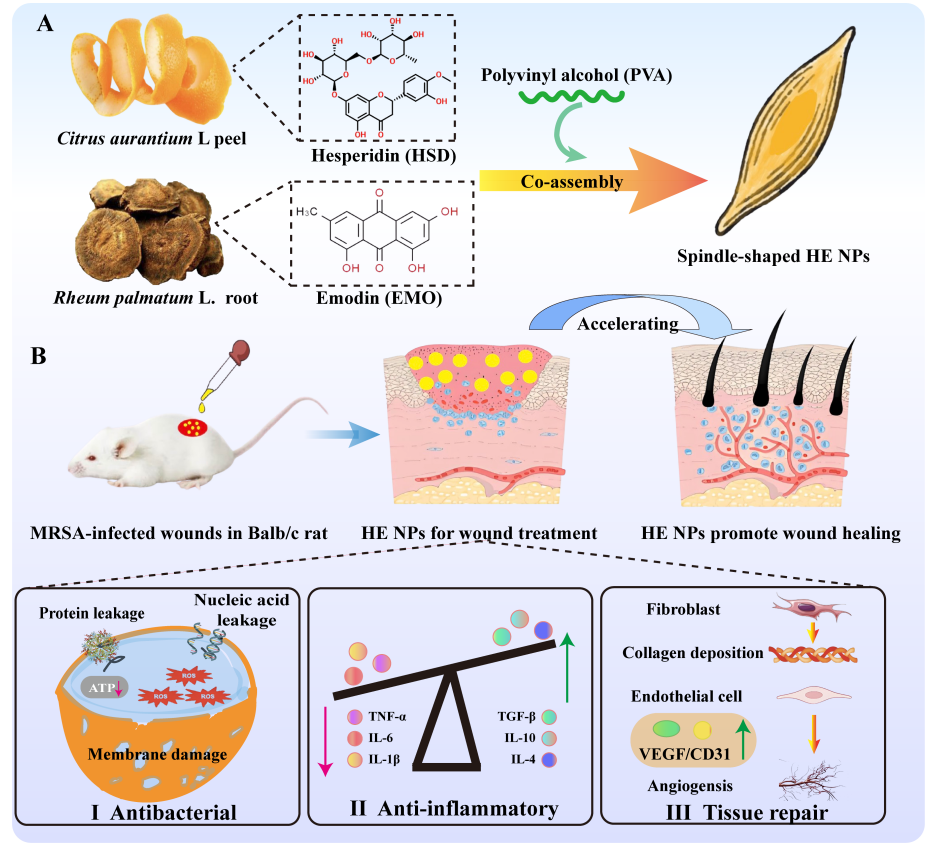
Schematic diagram of the preparation of HE NPs and their in vivo antibacterial and wound-healing efficacy
By Chang Li
(changli@caas.cn)